Current Appointments:
British Trust for Ornithology - Trustee
British Trust for Ornithology - Chair of Ringing Committee
RSK/BioCensus - Principal Ornithologist
Ringing and Migration - Associate Editor
Severnside Bird Ringing & Research Group
British Ornithologists’ Union - Scientific Programme Committee - Avian Disease Ecology (2027)
Natural England Twite Recovery Steering Group
Bird Survey and Assessment Steering Group
- Research Themes -
My research explores the diverse ways organisms interact with each other and their environments. I focus on social behavior, sensory ecology, and disease ecology, using wild birds as my primary study system. Through both descriptive and empirical approaches, I test ecological and evolutionary theory in natural populations.
1) Social Networks
I study the relationships between organisms using social network analysis and mixed-effects models. These networks map how individuals connect through shared space and time or through direct physical contact. My recent work applies these methods to understand disease transmission, particularly tracking the global spread of highly pathogenic avian influenza.
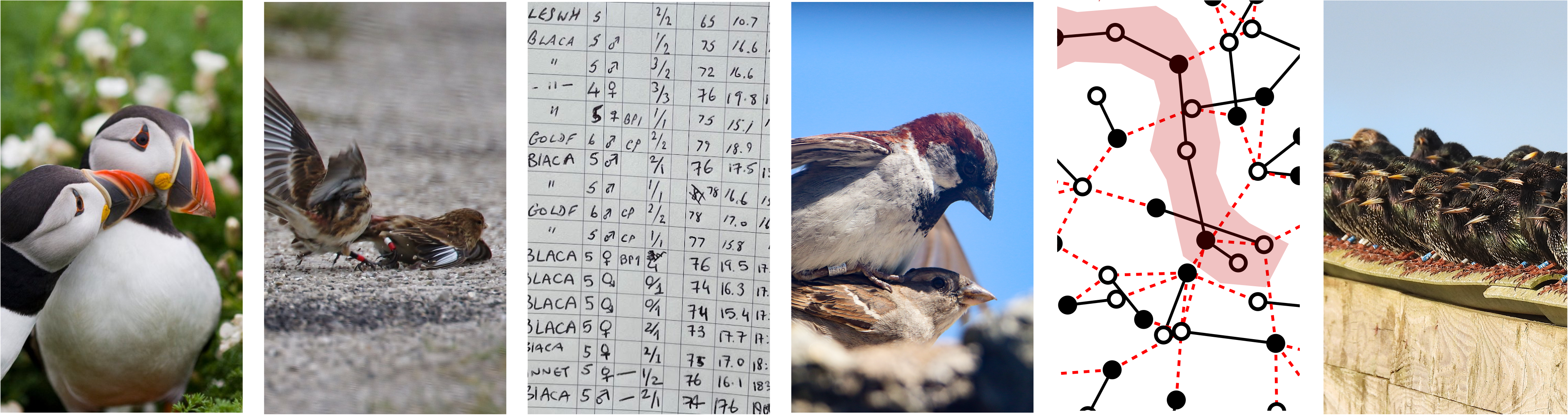
Highly Pathogenic Avian Influenza: Highly Pathogenic Avian Influenza (HPAI) poses an emerging threat to wildlife conservation, global food systems, and human health. Despite three decades of research, we still don’t fully understand what drives prevalence in wild bird populations, and recent outbreaks have diverged from historic transmission patterns. Working alongside Dr Alastair I. Ward and Dr Josh Firth, I explore how bird behavior at both species and community scales shapes HPAI transmission through co-occurrence networks.
Lundy Island House Sparrows: The long-term study of house sparrows on Lundy Island tracks a closed population with one of the longest genetic pedigrees of any wild bird on Earth. Every individual is monitored from egg to death, making Lundy an exceptional system for studying the evolution of animal behavior in real time. I first worked with these sparrows during my PhD in Quantitative Modeling in Ecology and Evolution at Imperial College London, supervised by Dr Julia Schroeder, Dr Tim Evans, and Professor Terry Burke. A complete genetic pedigree requires monitoring every breeding attempt and determining paternity for every offspring in the population. My work focuses on the evolutionary ecology of social traits and how they influence reproductive decisions, particularly female extra-pair reproduction. Female promiscuity presents an evolutionary paradox: it carries clear costs for females while offering limited benefits to either them or their offspring. As part of this project, I also explored how social networks structure interactions in dense bird flocks. My co-author Alex Chan has nicely summarized this body of work.
2) Visual Signalling and Communication
I am interested in the varied and complex ways that birds communicate information. While this connects to my work on social behavior, this research focuses specifically on the mechanisms of information transfer, particularly in challenging visual environments. This project demonstrates that the same signal can be interpreted very differently depending on the observer’s visual system and the light conditions in which communication occurs.
Physical and Vocal Signals: I am particularly interested in how birds communicate in challenging environmental conditions, such as at night or underground, where light is scarce and organisms must find novel ways to signal or conceal information. One striking example is the bill plate of Atlantic puffins, which fluoresces yellow-green under ultraviolet light. Similar observations were made earlier and later in related species. The communication function remains puzzling because it seems unlikely that these emission spectra are detectable in natural light conditions. We considered whether the fluorescence might simply be a developmental artifact—perhaps a bioaccumulation of green fluorescent protein (GFP) from marine copepods in the diet. However, this doesn’t account for how UV absorption might be perceived through avian visual systems, and recent research has suggested some degree of detection is possible. I have also explored adaptations for signaling in low light in woodcock (Scolopax sp.), whose tail feather spots are exceptionally bright among birds. Woodcock achieve this brightness through adaptations spanning from macro to nano scales. In our 2023 multidisciplinary paper, we described these structural adaptations and compared their reflectance spectra against a database of other white plumages. More recently, I have worked on the vocal communication of shearwaters, a group of nocturnal seabirds that breed in dense colonies. This work, conducted largely through supervision of project students, explores the information content of their calls and has potential applications in conservation monitoring.
Light Environment and Eye-type: Beyond understanding specific communication mechanisms, I’m also interested in the broader macro-evolutionary picture. Visual signals are typically studied from a human perspective—we describe colors physically or measure them with spectrophotometers. But animals have diverse visual systems and communicate in highly diverse light environments (in direct sunlight, under the forest canopy or at night), meaning they likely perceive and interpret these same signals very differently depending on context. Working with Prof John Endler, I have used large datasets of macro-ecological traits and contrast measurements to test how visual systems and light environments shape signal evolution.
3) Conservation and Population Biology
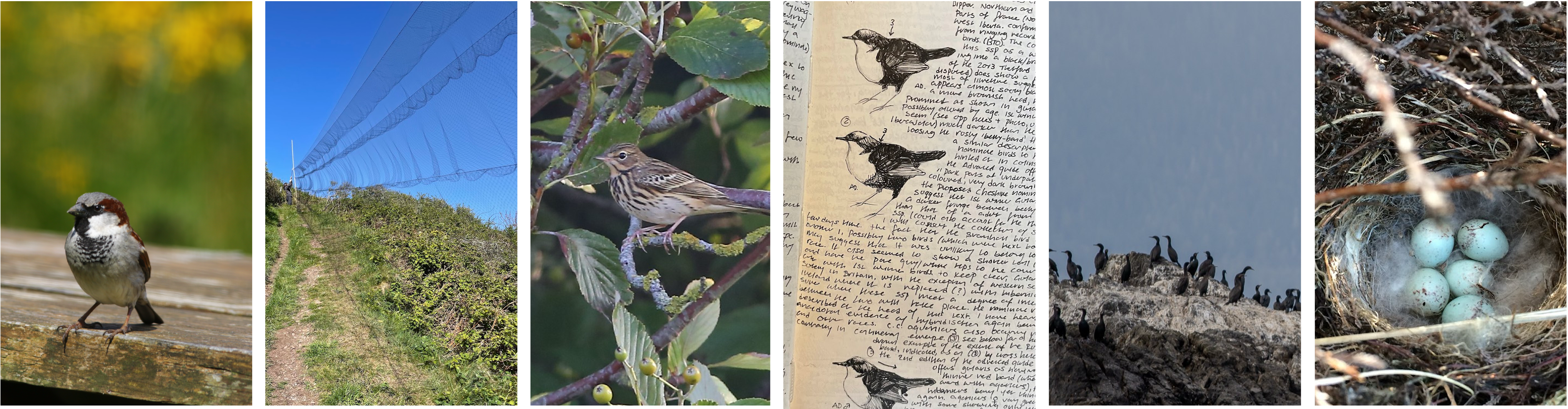
I work on several long-term conservation monitoring projects. While the Lundy project focuses on behavioral ecology, these projects are designed to understand how demographic factors like survival and productivity drive population trends. Much of this work is conducted through specific conservation groups, including the RSPB Twite Recovery Project, Christmas and Christmas, and Severnside Bird Ringing Groups. I hold an ‘S’ level bird ringing permit from the British Trust for Ornithology, where I am also a trustee and chair the ringing commitee, and chair Severnside Ringing Group, which involves both conducting species monitoring and training others in ringing techniques.
Mark-Recapture Data: Beyond the broader objectives of the BTO ringing scheme, I contribute to projects across multiple ringing groups, conservation charities, and statutory nature conservation bodies, working with diverse species and conservation goals. These include studies of gull productivity and spatial ecology on Steep Holm Island, reproductive behavior of Starlings on Lundy (alongside the sparrow work described above), white-eye ecology in human-modified rainforest, and a critically small breeding population of twite in England (see below).
Twite in the UK and Ireland (Linaria flavirostris pipilans): Twite (Linaria flavirostris) breed across Northern Europe, reaching their southern limit in the English Pennine hills. Their biogeography is particularly interesting, with isolated populations separated by large gaps and each exhibiting distinct ecologies. The English population has experienced dramatic decline, from approximately 164 breeding pairs in 2013—already a 75% reduction from a 1999 baseline—to fewer than 10 pairs by 2021. Since 2013, I have coordinated monitoring of breeding twite in England and, more recently, healthier wintering populations on the Mull of Oa, Islay, Scotland and in Shetland. Beyond conservation concerns, I’m fascinated by how the social behavior of these birds influences interactions between isolated populations and shapes broader demographic patterns. In 2017, I completed a research degree at the University of Nottingham examining genetic relationships between disjunct twite populations, supervised by Dr Kate Durrant and Professor Angus Davison. I have recently returned to phylogenetic analyses to understand the genetic factors underlying population decline and to inform conservation strategy.